The Menstrual Cycle and Your Feet: What the Research Says
Publication 14
The Part Nobody Mentioned
Most of us are used to the idea that our hormones drive mood shifts, skin changes, and energy fluctuations throughout the month. We've tracked the patterns, learned to recognize the phases, and built some version of cycle awareness into daily life. But there's one place hormones show up that almost nobody talks about — and it's about as far from the reproductive system as you can get.
Your feet.
A 2026 systematic review and meta-analysis published in Gait & Posture has confirmed what very little research had bothered to examine before: the menstrual cycle produces measurable, structural changes in the foot and ankle throughout the month. Changes that explain a surprising number of things — the mysterious arch ache that appears mid-cycle, the ankle that rolls more easily on certain days, the subtle sense that your footing just isn't quite right.
This is not a niche finding for athletes or sports scientists. It's relevant to anyone with a menstrual cycle who spends time on their feet — which is to say, everyone.
The research team screened over 1,600 scientific articles and selected 15 that met rigorous quality standards. All participants were women with regular cycles and no hormonal contraceptive use. It's the most comprehensive look at this topic to date — and what it found is worth understanding.
Your Feet Actually Change Shape Mid-Cycle
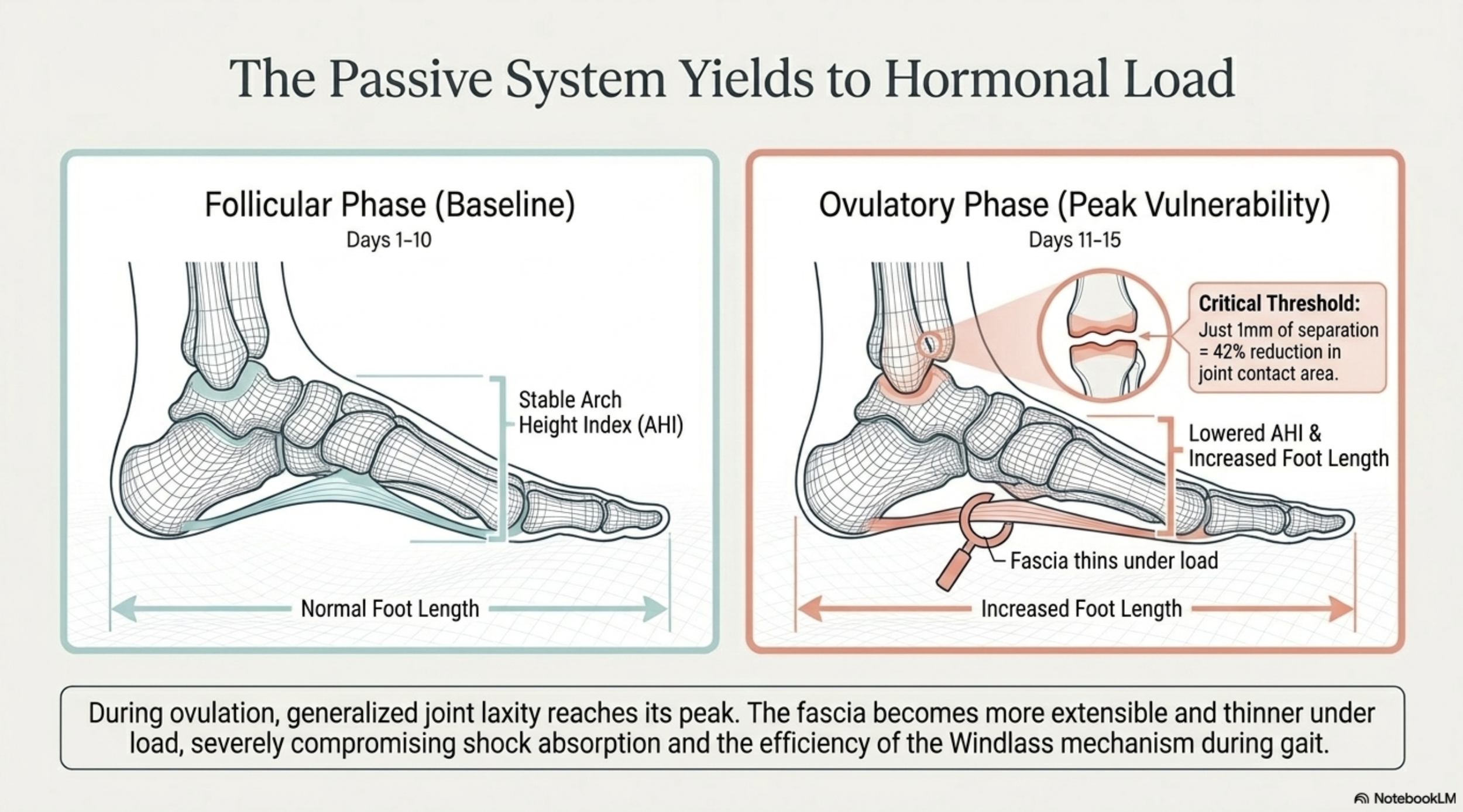
During the ovulatory phase — roughly the middle of the cycle — research consistently documented a measurable increase in foot length and a reduction in the thickness of the plantar fascia under load. The plantar fascia is the broad band of connective tissue running along the sole of the foot; it's what gives the arch its structure and its ability to absorb impact.
This happens because estrogen peaks just before ovulation and acts directly on the tissues that keep tendons, ligaments, and fascia firm. At the same time, a hormone called relaxin — which also rises around ovulation — actively works against the collagen that gives those tissues their structure.
The result is a foot that is temporarily more elastic, more spread out, and less structurally supported than it is at other points in the month. The arch lowers under load. The foot elongates slightly. And the system that normally manages shock absorption with every step becomes less efficient.
If there's a recurring arch ache that appears and disappears without obvious cause, or a sense of heaviness in the feet around mid-cycle, this is likely the explanation. It's not random. It's cyclical.
How the Cycle Affects the Feet From Phase to Phase
The changes don't only happen at ovulation. Each phase of the cycle brings its own set of shifts — and mapping them out makes it much easier to recognize what the body is doing and when.
The follicular phase — the first part of the cycle, as estrogen begins to rise before ovulation — is where the body appears most structurally stable and most responsive. If there's a window in the cycle where everything feels like it's working with you rather than against you, this is likely it.
At ovulation, that stability is at its lowest point. Estrogen and relaxin peak together, ligaments loosen, the arch drops, and the foot becomes temporarily less supported. This is explored in more detail in the sections below.
In the luteal phase — the second half of the cycle, when progesterone takes over — a different set of issues emerge. The ankle loses some of its range of motion, making it harder to flex the foot upward naturally with each step. That restriction puts more pressure on the plantar fascia over time, and gradually shifts how the whole leg compensates — the hip rotates inward, more load moves to the front of the foot, and structures that weren't designed to carry that demand start to feel it.
During the menstrual phase, the research points to something more neurological than structural. Reaction times are slower. The body's sense of where it is in space becomes slightly less accurate. Pain and inflammation during menstruation appear to dull the sensory signals the body relies on to stay balanced and coordinated.
The Brain Is Working Overtime — But It's Not Enough
Here's one of the more striking findings in this research. The nervous system senses the increase in ligamentous laxity around ovulation and responds by sending stronger signals to the muscles around the ankle, essentially trying to compensate for the reduced passive support with increased muscular effort.
But despite those stronger signals, the muscle's capacity to respond is itself blunted by the same hormonal environment creating the instability in the first place. The message is going out louder than usual, but the muscles can't fully answer it.
Researchers call this electromechanical dissociation: the motor control system is working at full volume, but the physical response can't match the demand. The practical outcome shows up in the data as significantly increased postural sway and balance oscillation during challenging tasks — particularly those that require balance or quick changes in direction.
This is the scientific explanation for the wobble that appears on certain days. The body isn't failing but it is in a temporary state of compensatory overload.
And It Doesn't Stay in the Foot
The foot is the foundation for everything above it, and instability at that level doesn't stay contained. When the arch lowers and the foot becomes less stable, the shin rotates inward, which pulls the knee medially — creating stress in the knee joint that wouldn't be there if the foot were fully stable.
The ankle is also directly affected. The ligaments that hold the ankle joint together loosen around ovulation along with everything else. Research found that just 1mm of additional separation in the ankle joint reduces its load-bearing surface area by 42%. One millimeter, nearly half the contact area. That's how much this tissue laxity matters mechanically, and it explains why ankles tend to roll more easily at certain points in the month.
Why This Research Matters Beyond Biomechanics
One of the most significant gaps in medical research has been the long-standing assumption that women's bodies behave like men's bodies — with hormonal variation simply layered on top. Most of what we know about musculoskeletal function and movement biomechanics was established using male participants, or women studied without any reference to where they were in their cycle.
Research like this is filling in decades-old gaps. The foot and ankle are just one piece of a much larger picture of how cyclical hormonal change shapes the way the body works, moves, and responds to load.
The body is more cyclical than we have ever been taught — and that cycle reaches further than most of us have ever been told to look.
What to Do With This Information
For everyday movement, the most useful thing this research offers is context. If foot discomfort or balance issues show up predictably at certain points in the month, tracking that alongside the cycle can turn a frustrating pattern into useful information.
For those who are more physically active, the research supports pulling back on high-impact activity around ovulation and focusing on balance and stability work instead — simply because passive structural support is at its lowest during this window.
In the luteal phase, dedicated calf and ankle stretching helps address the reduced range of motion that builds in the second half of the cycle.
And for the plantar fascia specifically — the arch tissue that thins and loosens mid-cycle — short foot exercises are worth knowing about. The movement involves contracting the arch without curling the toes, as if gently drawing the ball of the foot toward the heel. It activates the small muscles inside the foot that provide active arch support when the passive support temporarily decreases.
None of this requires overhauling a routine. It requires knowing what's happening — and now, that's exactly what this research gives us.
Source: Regife-Fernández, L., Radcliffe, C. R., & Castro-Méndez, A. (2026). Menstrual cycle effects on foot and ankle musculoeskeletal biomechanics: A systematic review and meta-analysis. Gait & posture, 127, 110164.
Read the full review article here → https://doi.org/10.1016/j.gaitpost.2026.110164